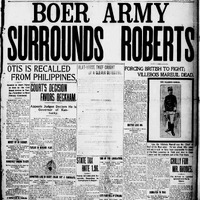
Taylor in Murder Plot
Item
- Title
- Taylor in Murder Plot
- Source
- Evening World
- Date
- 6-Apr-00
- page
- 1
- Identifier
- Image 1 of The evening world (New York, N.Y.), April 6, 1900, (Evening Edition) | Library of Congress (loc.gov)
- Crime
- Murder
- Subject
- Assassination, shot
- Gender of alleged offender
- Male alleged murderer
- Gender of alleged victim
- Male alleged victim
- Stage of the Legal System
- Court
- Length of story
- 338 words
- Description
- Louisville, KY. April 6 - Henry E. Youtsey, the Newport stenographer, now under arrest for complicity in the assassination of Goebel has, it is said, made a complete confession of the crime. He charges that the fatal shot was fired by "Jim" Howard, who previously had one murder to his credit. Youtsey further declares that in the conspiracy to remove Goebel were Gov. W. S. Taylor, Secretary of State Caleb Powers, ex-Secretary of State Charles Finley, Capt. John Powers, of the Barbourville militia company; Sergt. Wharton Golden, of the same command; W. H. Culton, clerk in the office of Auditor Sweeney, and himself. Other men were named, but their connection with the assassination is not so direct. "The plot," says Youtsey, "was hatched in the office of the Secretary of State, Caleb Powers, and all the men named had full cognizance of the purpose to shoot down William Goebel." A price was placed upon the man's life, and the sum paid over was $1,600, which Youtsey says he himself handled. The $1,600, as the first instalment, was paid just before the fatal shot was fired. Youtsey is to turn State's evidence and he expects to be granted immunity. He does not attempt to conceal his own part in the conspiracy. In his confession, he admits that he purchased the 35-calibre Marlin rifle, the bullets and the smokeless powder used to kill Goebel. He charges that the Powers brothers, Charles Finley, and a few others hatched the plot and that he, with the two Howards, Culton, and two others took part in its execution. Youtsey swears that Gov. Taylor and seven other men knew that Goebel was to be assassinated. The Governor, he says, would not trust "Tallow Dick" Combs, the negro who was first selected to do the killing, and another man was picked out. This man declined to act until he was paid. An agreement was made, and just before the shot was fired, the $1,600 cash instalment was paid over in the Executive Building.