
Marking presence
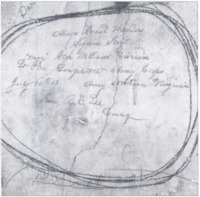
"Inscriptions marked soldiers’ presence in, and journeys through, the wartime landscape." Like letters, graffiti "implied an assertion of the writer’s importance."
Soldiers who did more than simply write a name and unit were making a particular effort to record their presence. Charles Schingermann wrote his name across an entire wall in the attic of Blenheim House, as did Michael Bowman, in more careful handwriting, at the Graffiti House. Others wrote their names multiple times. Still others decorated their names; a wreath and crown in the case of Theodore Rasfle in Blenheim House; formal handwriting in the case of Henry Van Ewyck; the style of a carved inscription in the case of Henry A Jones at Frederick Courthouse; and in a scroll in the case of the gun team at Graffiti House.
Marking their presence with graffiti in this way, soldiers behaved in a similar way to nineteenth-century tourists, who wrote their names on sites like the caves in the Shenandoah Valley. Like tourists, Union soldiers in particular were in unfamiliar territory, traveling far from home usually for the first time. Some of the graffiti was written in the context of siteseeing and souvenir gathering, ranging from visits to caves already featuring graffiti to churches reputedly attended by Washington such as the Falls Church, from which soldiers carried away boards as well as writing their names on the walls.
"A more likely explanation is that for Union soldiers adventuring outside of their home states, inscriptions were made to claim control of new territory, not so much like tourists of past generations, but in a manner more similar to modern “tagging” in graffiti."