| Assignment | Grade | Due Date |
| Newspaper Description | 15% | September 15 |
| Search Results | 50% | September 18-November 20 |
| Dataset | 10% | December 1 |
| Online Exhibit | 25% | December 16 |
- No late work will be accepted.
- Extensions will be given if circumstances beyond your control prevent you from submitting work by the due date. Having work due in other classes is not grounds for an extension.
- You must request an extension before the due date.
1. Newspaper Description (15% of grade)
due by 11.59PM, September 15
The goal of this assignment is to develop an overview of the paper that you have chosen to research to provide a context for understanding the crime reporting that you will be investigating in the rest of the course.
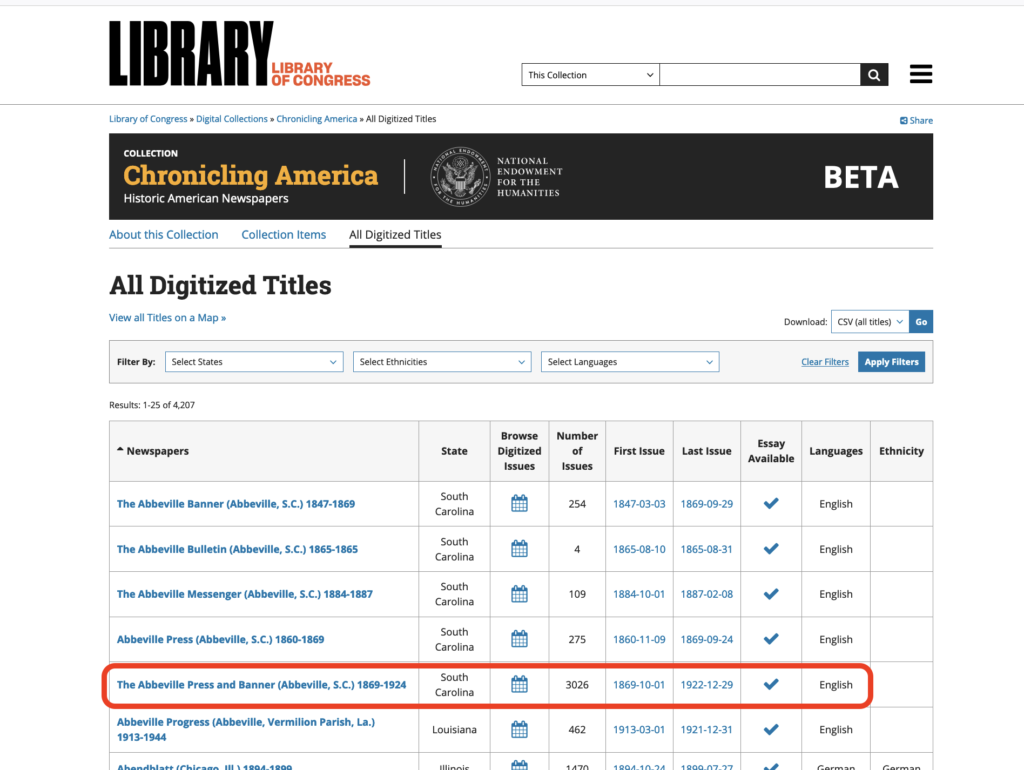
To choose a newspaper, in Chronicling America:
[NB Check you are using the new BETA site shown in the image below]
- click on the tab “All Digitized Titles.”
- Filter By – select a state – then scroll through looking for newspapers with large numbers of issues and first issues and last issues that cover a 20 year time period
- The newspaper you choose must have issues from 1880-1900 or 1900-1920
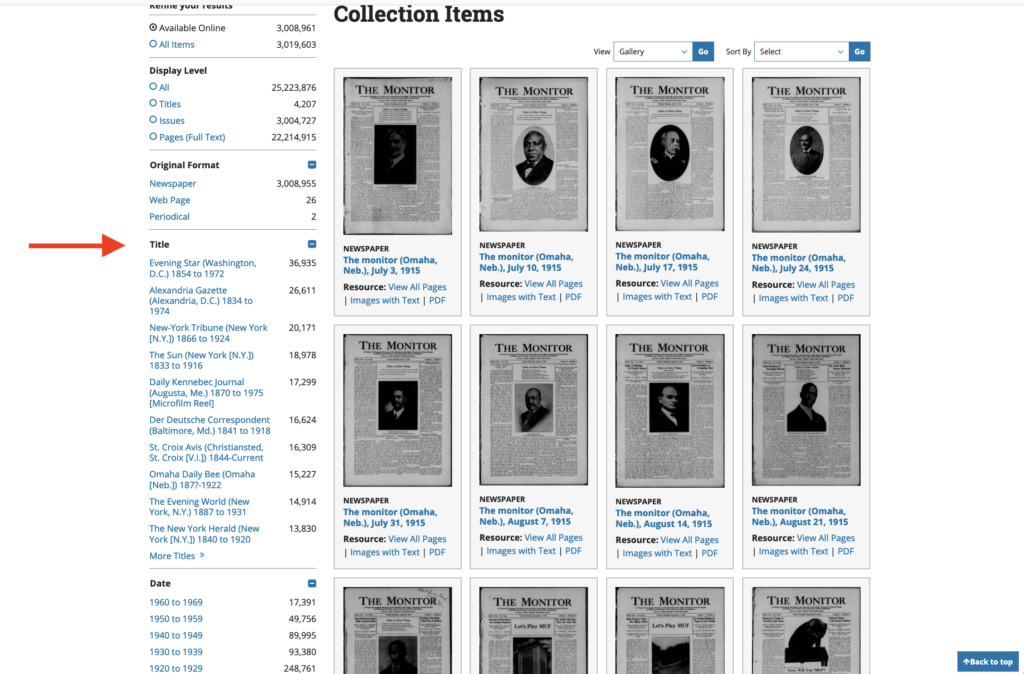
- OR Click on the tab Collection Items
- In the left menu there is a list of titles ranked by the number of issues
- OR choose from this list of examples of newspapers that cover the required period.
- Choose a time period: 1880-1900 or 1900-1920
Skim a week of issues of the newspaper you have chosen from two different years (1880 & 1900 if you chose that period or 1900 & 1920 if you chose that period), and write a 750-1000 word paper that answers the following questions:
- Identify the newspaper (its location, editors, audience etc)
- Read the essay on your newspaper in Chronicling America – click on the link in the list of All Digitized Titles
- For information on circulation of your newspaper, check here
- Estimate the accuracy of the OCR for your newspaper – select 100 words from a story in 1880 or 1900, compare with the image of the story, and count how many characters are correct; repeat for a story from 1900 or 1920. What caused the errors? Are there patterns in what letters are wrong, or where on the page the mistakes are?
- Identify the two weeks of issues you have examined
- How many pages and columns are in each issue?
- What kind of content is on each page? (news (local, state, national; international); features; ads etc)
- What style of content? (Melodramatic, Sensational, Objective)
- What format of presentation? (headlines, illustrations, length of stories)
- In what ways was the paper different 20 years later? (1880 vs 1900 or 1900 vs 1920)
- How, and on what basis, would you categorize the paper, in terms of the genres of the penny press, sensational press, informational press? (see chart)
Email the assignment to Prof. Robertson
2. Search results (50% of grade)
due before 10 AM each Wednesday class*
In weeks 4-13, after spending the Monday class examining historical accounts of a crime, we will spend the Wednesday class analyzing the reporting of that crime in the newspapers each class member has chosen to research (*except for Week 8, when we will analyze both historical accounts and reporting in the Monday class).
Search your newspaper in Chronicling America for the crime that is the subject of that week in the time period you chose (either 1880 & 1900 or 1900 & 1920). (Instructions for choosing a newspaper are in assignment 1)
- NB: You search the same newspaper and the same time period every week
Instructions with screen shots
- Click on the “Advanced Search” Tab
- In the row of buttons lick the “Pages (Full Text)” button
- In the search terms, add a term from the list in the syllabus
- If the term is a phrase, click on ‘any of these words’ and change it to ‘this exact phrase’
- Select State and choose the state of your newspaper, then click on title and choose your newspaper
- For each year (1880 & 1900 OR 1900 & 1920), begin by searching for the period 6/1 – 6/30
- EG, if you are researching 1880 and 1900, in start date, put 06/01/1880; in end date put 06/30/1880
- find at least 20 stories about the crime from 1880
- then in start date, put 06/01/1900; in end date put 06/30/1900
- find at least 20 stories about the crime from 1900
- if a search for the whole month produces too many results, search for 6/1 – 6/15; continue to reduce the time frame until you have a manageable set of results
- if a search for the whole month produces too few results, extend the period of the search to include additional months or years
- EG, if you are researching 1880 and 1900, in start date, put 06/01/1880; in end date put 06/30/1880
- Check each result to ensure the story relates to a crime (eg is not a fictional story, or a use of the search term as a metaphor, or refers to a war etc)
- For items that are crimes, scroll to the top of the page and click the share link to copy the url or copy the url in the address bar of your web browser
- Paste the url into a Google sheet titled with the date and a brief note on the details of the crime
- Choose one story from your results as an example of the language used to describe the crime
- Share the completed sheet and the story you chose as an example with Prof. Robertson: srob4757@gmail.com
- Come to class prepared to discuss your search results and the story you chose; a portion of the grade for each week will be determined by class participation.
- Each set of search results is worth 5% of your grade, for a total of 50%.
3. Dataset (10% of grade)
due by 11.59PM, December 1
Choose one of the crimes studied in the course and develop your search results for that crime into a data set of at least 40 stories
- Create and complete a Google Sheet that analyses your stories, modeled on the example provided in the detailed instructions (including columns for location, keywords describing the nature of the crime, gender and race of the alleged victim and offender, the law enforcement personnel involved, and what stage of the legal system is being reported (crime, arrest, arraignment, trial, sentencing).
- Save the Google Sheet as a csv file and share it with Dr Robertson (srob4757@gmail.com)
4. Online exhibit (25% of grade)
due by 11.59PM, December 16
Create an Omeka S exhibit interpreting your dataset (assignment #3) that outlines the patterns in the data and interprets them by answering these three questions:
- How do these stories fit with historians’ accounts of crime reporting? (refer to the lectures and readings for Weeks 1 & 2)
- How do these stories fit with historians’ accounts of that crime? (refer to the resource for that crime included in the schedule)
- How do these stories compare with those discussed in an existing student project on this type of crime?
We will spend a class in Week 12 on exhibit building using Omeka S.
- Example exhibit mockup
- Example student assignment: Rejina Tabay, Rape in the Morning Appeal, 1880 & 1900 (2019)
The total writing in the exhibit should be 1500-2000 words
The site should include at least 8 pages:
- An about page that describes your newspaper and the search you did to create your dataset (based on material from assignment #1)
- At least one page discussing patterns in where the crimes took place, referring to the map you made, and discussing if there was any change over time
- A map of the location of the crimes made with the Omeka Map Plugin
- At least one page discussing patterns in the the nature of the crime, and discussing if there was any change over time
- If you have a case reported in detail, you should make a page devoted to that case
- You can search the HEINONLINE State Statutes for the laws regarding your crime (choose the statutes for your time period)
- You will likely find that this analysis requires more than one page – with separate pages for each pattern that you found
- At least one page discussing the gender of the alleged victims and offenders, and discussing if there was any change over time
- At least one page discussing the race of the alleged victims and offenders, and discussing if there was any change over time
- At least one page discussing what stages of the legal system feature in the stories
- At least one page discussing the language used in the stories
At least one page comparing the stories with those discussed in an existing student project on this type of crime (and comparisons on relevant pages on specific topics)
- Due to an error with the site, older projects are not currently accessible so you do not need to do this as part of your project
In each page
- include the items/stories you are discussing (not just those you write about but all those in the group/pattern) and any relevant charts you created of your dataset (use material from assignment #3)
- answer the two questions, about how the stories fit with that aspect of historians’ accounts of the crime and of crime reporting
- Only use the readings assigned in the course – do not do additional research
- When you reference a reading, include an in-text citation (eg Estelle Freedman, “”Crimes which startle and horrify”: Gender, Age, and the Racialization of Sexual Violence in White American Newspapers, 1870-1900,” Journal of the History of Sexuality 20, 3 (2011): 472)
Instructions for Omeka S
- Importing your dataset into Omeka S – Professor. Robertson will import your dataset
- Login to the site: https://drstephenrobertson.com/chroniclingcrime/admin
- Creating a site in Omeka S – Instructions
- Creating pages in Omeka S – Instructions
- Organize your pages in Omeka S – Instructions
- Mapping your dataset in Omeka S – Instructions
- Adding an item to Omeka S – Instructions
- Creating a chart in Google sheets – Instructions
You do not need to submit the site once you are done; Professor Robertson has access to all the sites. If you finish before the deadline, you can let him know that he can grade your site.
