
Melrose Caverns
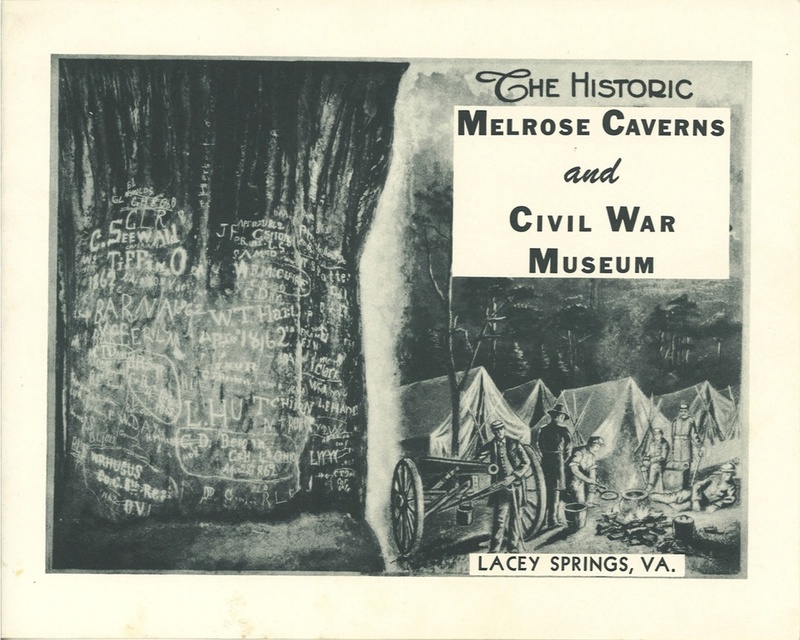
Union and confederate soliders carved their names on the walls and columns of the caves.
"The greatest numbers of these dates are from 1862, attributed to the appearance of Union forces under the command of General Nathaniel P. Banks, who marched south from New Market along the Valley Pike and rested on Sunday, April 28, at the Harrison Farmstead.The troops soon discovered the opening to the cave and explored them with candles and torches, inscribing hundreds of names, either written in charcoal from the torches or carved with a sharp instrument such as a knife or bayonet. Most of these names are from the 4th, 7th, 8th, and 29th Ohio Volunteer Infantries. Other names are attributed to the June 1862 presence of Union General John C. Fremont’s forces in the Valley. Inscriptions also include soldiers from Indiana, North Carolina, and Maryland."
National Register of Historic Places Registration Form (2014)
"Union soldiers’ signatures in Melrose Cave include an initial and a last name, like inscriptions of tourists in the previous generation. But soldiers’ inscriptions also often include demonstrations of common unit identity through an additional line including the inscriber’s state and regiment number. At Melrose Cave, many of the soldiers’ inscriptions are from Ohio regiments passing through the valley. “O.V.I.” is a common inscription, standing for “Ohio Voluntary Infantry.” Examples include “1862 L.G. Lester, 4th Ohio Reg.”, “ J. Hollabaugh, Co. A., 4th Regt. OVI, 1862”, “Thomas Cool, Co. K. 14 Regt. Ind. Ap. 29th 1862”, “Harry Fisk, Co. A, 7th Ind.”, “W.J. Grimwold, C.A. 4 Reg. OHIO VI, Apr. 1862”, “T. Gillet, A. 7th. O.” “W.P. Hucus, Co. C., 8th Reg., O.V.I.” , “J.McAdams, Co D 7th Ohio”. Some are written apparently with black ink on the surface, such as “W. Ho[gand?] Co. C. 8 Regt. OVI”, and “[John?] Sohermen Co. C. 4. R. O.V.I, [Fred?] Kenton Hardin., [Dou ntx.?] Ohio, Aprill. 28. 1862.” In one instance, it appears that a descendent many have visited the cave and carved a signature underneath. “E.P. Shephard, Oberlio, Ohio” and “L.G. Wilder, May 4th, 1862, C. 7th O.V.I.” are together circled while “W. SHEPARD, 6-5-22, Wash.” is found below."
"In Melrose Cave, there is a prevalence of engraved flags, including both the Stars and Stripes, and the Stars and Bars. An early flag inscription in the cave must have served as inspiration for later inscribers. On a visit to Melrose, I documented five examples of the stars and stripes, although there likely were additional examples that have faded away. In each preserved instance, the flag flies to the right of the flag pole, and the stars are in the upper-left of the flag. One is made with seven roughly parallel lines (thereby making six spaces in between for the 13 stripes). Another flag, rising above the inscription of W.P. Hucus, is a flag in motion, again unfurled to the right. The flag may originally have had clear stripes, but erosion or vandalism has dulled the image. Another is engraved in a brown and white wall and is a rough Stars and Stripes with a short pole. Again the flag flies to the right. A fourth flag, made of twelve engraved horizontal lines, shows that soldiers were not always particularly careful in creating accurate images. A fifth flag, the poorest representation of the lot, demonstrates this further. It has a clear vertical pole with eleven scarred horizontal lines and no attempt to box off a starred corner. The diversity of images is a reflection of the relative artistic talent of the soldiers, as well as an indication of their attitudes. Most of the flags, for example, appear to have been carved in relative haste. An additional flag may be a “Stars and Stripes” or a “Stars and Bars,” but it has been damaged by water erosion."
"An author from 1937 claimed that there was a charcoal portrait of President Lincoln made on the wall of Melrose Cave dating to April 1862. A newspaper article from 1934 confirms this and adds that there was an American eagle carving as well. In my visit to the cave, I was unable to locate either image."