
The Metropole, the official blog of the Urban History Association, has published a post I wrote on Harlem in Disorder. The post describes the origins
More...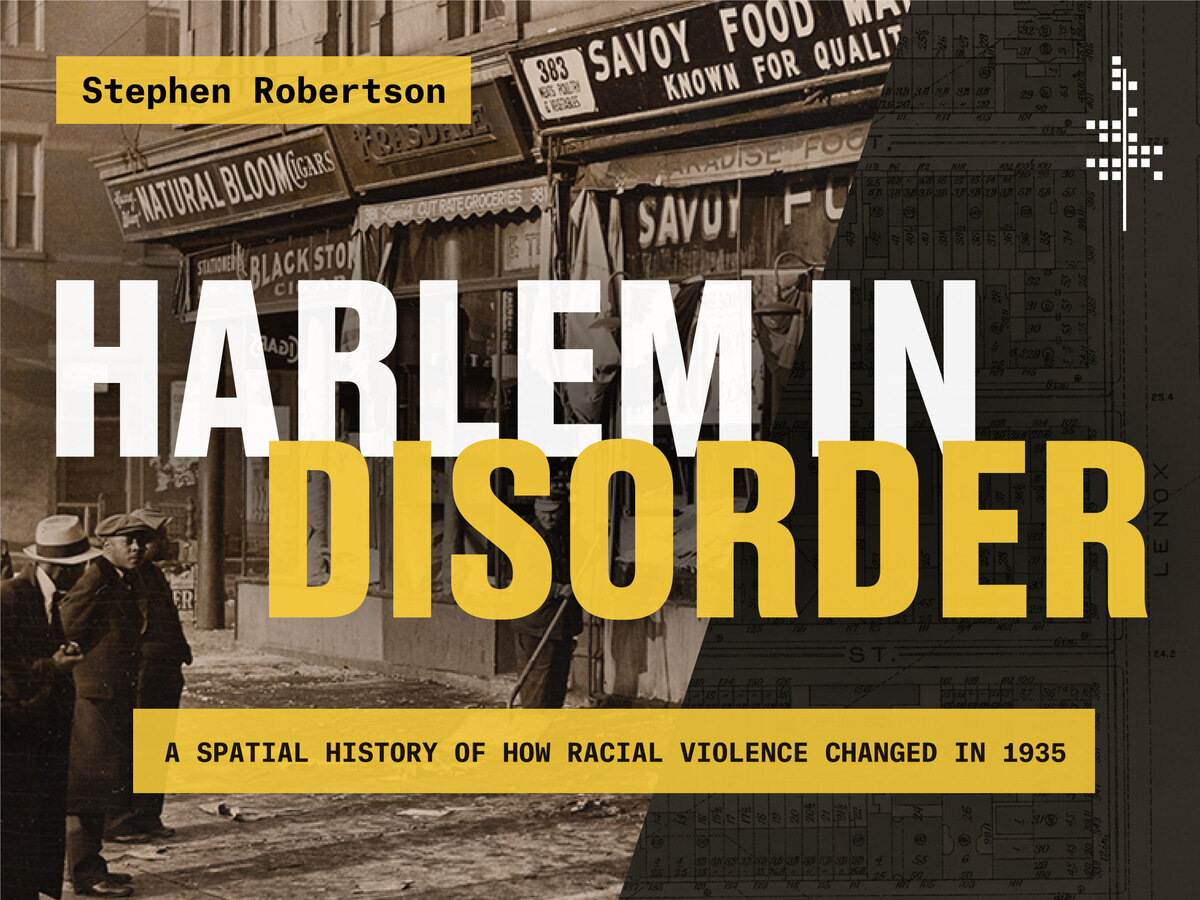
On March 5, 2024, my open access digital monograph, Harlem in Disorder: A Spatial History of How Racial Violence Changed in 1935, was published by
More...
My article “The Properties of Digital History” appeared in the December 2022 issue of History and Theory. It originated in an invitation from Jesse Torgerson
More...
This semester I will be teaching a new course, Digital Scholarship, examining the digital forms in which historical scholarship can be published. The idea for
More...
The Models of Argument-Driven Digital History website launched today: https://model-articles.rrchnm.org/. It contains a set of published journal articles annotated by their authors to highlight the
More...
A book chapter I co-authored with Lincoln Mullen, “Navigating through narrative,” has appeared in Making Deep Maps: Foundations, Approaches, and Methods, a collection edited by
More...
This week the National Endowment for the Humanities awarded me a NEH Mellon Fellowship for Digital Publication to support “Harlem in Disorder: A Spatial History
More...
On the Digital Harlem Blog I’ve posted the preprint of my long forthcoming chapter on using Digital Harlem to teach the Harlem Renaissance (finished in
More...
Like many DH teachers, I have had to look for an alternative to Carto to introduce students to digital mapping now that they have fully
More...
On February 3, 2017, I delivered the keynote address at the 9th Annual Bridging the Spectrum Symposium on Scholarship and Practice in Library and Information
More...
My article “Searching for Anglo-American Digital Legal History,” has been published in Law and History Review 34, 4 (November 2016), a special issue on digital legal history. ABSTRACT
More...
“Toward a Spatial Narrative of the 1935 Harlem Riot: Mapping and Storytelling after the Geospatial Turn,” New Approaches, Opportunities and Epistemological Implications of Mapping History Digitally:
More...
My chapter, “The Differences between Digital Humanities and Digital History,” has appeared in Debates in Digital Humanities 2016, expertly edited by Lauren Klein and Matt Gold
More...
The February 2016 issue of the American Historical Review includes an extended review of Digital Harlem — “Harlem Crime, Soapbox Speeches, and Beauty Parlors: Digital Historical Context and
More...
[Cross-posted from the RRCHNM blog] This is the text of my presentation in the session on the future of digital humanities centers, on day two
More...
On November 21, 2014, I’m presenting a paper titled “Collecting Grains of Sand: Big Data and the History of Ordinary Individuals” as part of the
More...
This is the second in a series of posts about aspects of RRCHNM’s history written to mark the Center’s 20th anniversary. No sooner had I published
More...
This is the first in a series of posts about aspects of RRCHNM’s history written to mark the Center’s 20th anniversary. (The second post is
More...
This course is my version of HIST 696, the first of the two digital history courses required of all PhD students at GMU. I was introduced to this
More...
Roundtable at the Urban History Association Biennial Conference, Philadelphia, October 10, 2014 Chair and Moderator: LaDale Winling, Virginia Tech Participants: Colin Gordon, University of Iowa
More...
The revised & expanded version of this post published in Debates in Digital Humanities 2016 is now online. For the last nine months I’ve spent much
More...
On April 1, I’ll be giving two talks on Digital Harlem at the University of Pennsylvania. Behind the Scenes at Digital Harlem Tools-and-Techniques in the
More...
HIST 390 The Digital Past Spring 2014 Syllabus This course is my version of HIST 390, the course first developed by Dan Cohen, which satisfies
More...
Moving means packing up my office. As you can see, on one side of the office are books; on the other, filing cabinets and piles
More...
HSTY4011 Digital History New Honours Seminar Description: New technologies are transforming the work of historians, and the ways in which we interpret the past and
More...