Marriage and Divorce
Consider Flower married Mary Henderson on July 13, 1876, in Gowanda, approximately 20 miles east of Angloa, where he lived at the time.
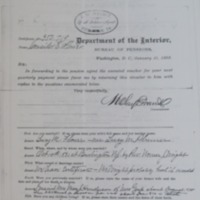
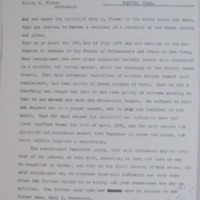
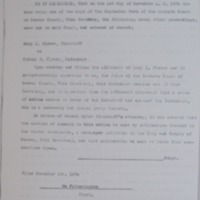
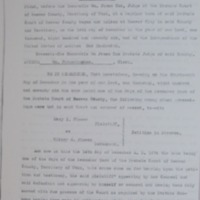
The couple separated 9 months later, in April 1876. Eight months later Mary obtained a divorce in Beaver County, Utah, on the grounds that Flower had a bad temper, abused her with his slanderous tongue, and did not support her.
In the 1870s, Utah had some of the most permissive divorce laws in the United States. A law passed by the Mormon dominated state legislature in 1852 included an omnibus clause that allowed judges to grant divorces "when it shall be made to appear to the satisfaction and conviction of the court that the parties cannot live in peace and union together and that their welfare requires a separation." New York, by contrast, granted divorce only on the grounds of adultery. The Utah law also included made it easy to obtain the residency required to obtain a divorce in a state: a court needed only to be satisfied that a petitioner "wishes to become [a resident of the Territory]." The transcontinental railroad made it possible for women like Mary Flower to relatively easily journey to Utah's courts, and New York lawyers consequently flooded the state with cases. (The Utah law was amended a year after Mary obtained her divorce, in 1877, to remove the omnibus clause and add a requirement of a year of residence)
[Glenda Riley, Divorce: An American Tradition (University of Nebraska Press, 1997), 96-98]
[Sarah Barringer Gordon, "The Liberty of Self-Degradation: Polygamy, Woman Suffrage, and Consent in Nineteenth-Century America," The Journal of American History, Vol. 83, No. 3 (Dec., 1996): 842-844]