
Pension Application
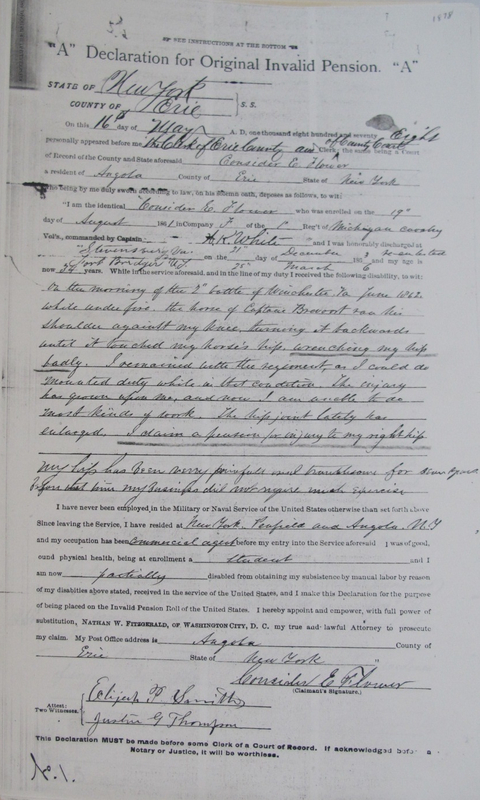
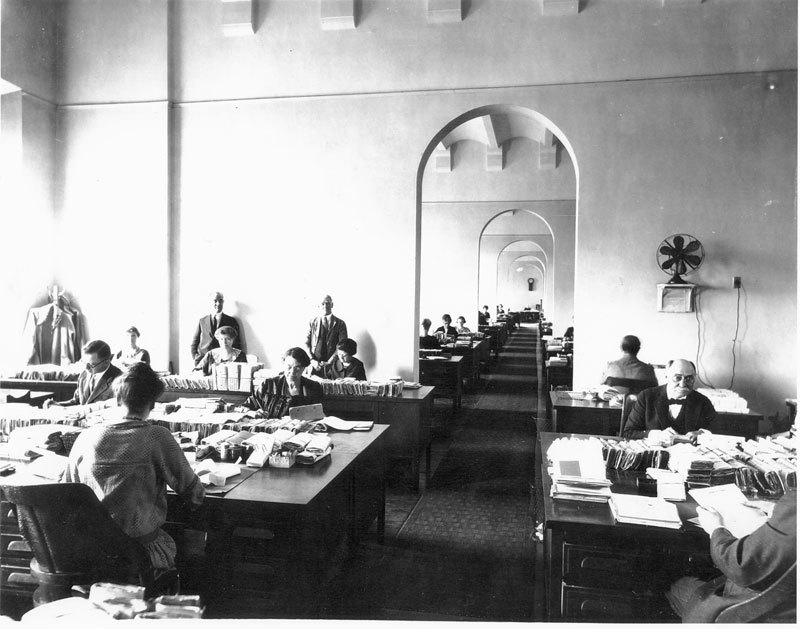
In May of 1878, while living in Angola, NY, Flower applied for a pension. Congress had established a Union Army pension program in 1862. it provided financial support for soldiers who suffered permanent bodily injury or disability in the service, with the amount dependent on the serverity of the disability.
Although the pension had been avaiable to him from the time he mustered out fo the army, Flower held off applying for a pension until 1878 because, until 1871, his "business did not require much exercise." However, since then, during which time he had worked as a salesman, his "hip had become very painful and troublemsome" to the point where he was "unable to do most kinds of work."
Following its process, the Pension Bureau forwarded Flower's application to the Adjutant-General's office in the War Deparment to confirm his military service. In September they received a reply that outlined his service, but crucially for the outcome of his application, closed by noting that "The records of the Office furnish no evidence of injury June 1862."
In March 1879, in New York City, a surgeon named William McDonald examined Flower. He reported that he found no physical evidence of injury and that Flower was not incapacitated. On that basis, in April, the Pension Bureau rejected Flower's application.
In April 1881, Flower, now living in Eatontown, NJ, tried again.
He filed an affidavit that he not received treatment for his injury; instead his captain excused him from duty for a few days once the unit completed its retreat.
He followed that with a second affidavit attesting that he could not get either of the Captains under which he had served to confirm his story, as both had been killed in action, nor did he know the whereabouts of any comrades who might confirm his story.
Instead, he solicited affidavits from John Ellenger, H Anchonpaugh and J G Thompson about his condition when they knew him, in New York state in the late 1870s. It took until June for those affidavits to be completed.
Flower's acquaintances described his condition as ?.
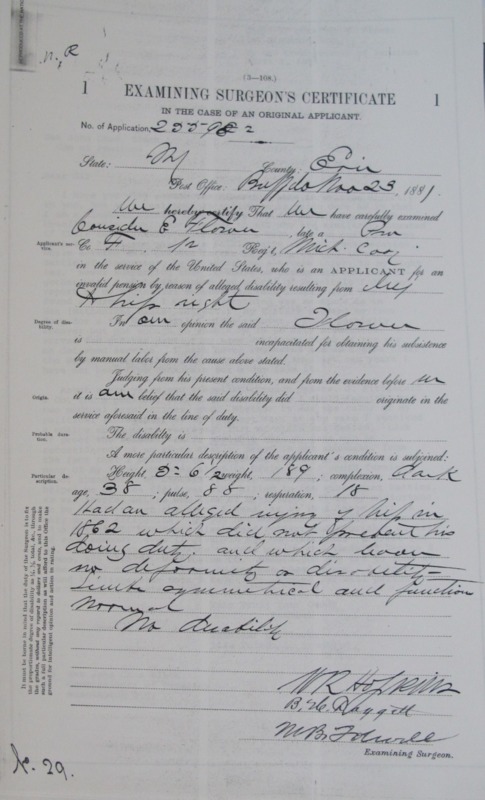
But once again, the surgeon that examined him for the Pension office in November 1881, found no evidence of deformity or disability.